Genis RIGOL Brunilda à la Plata
Presentation
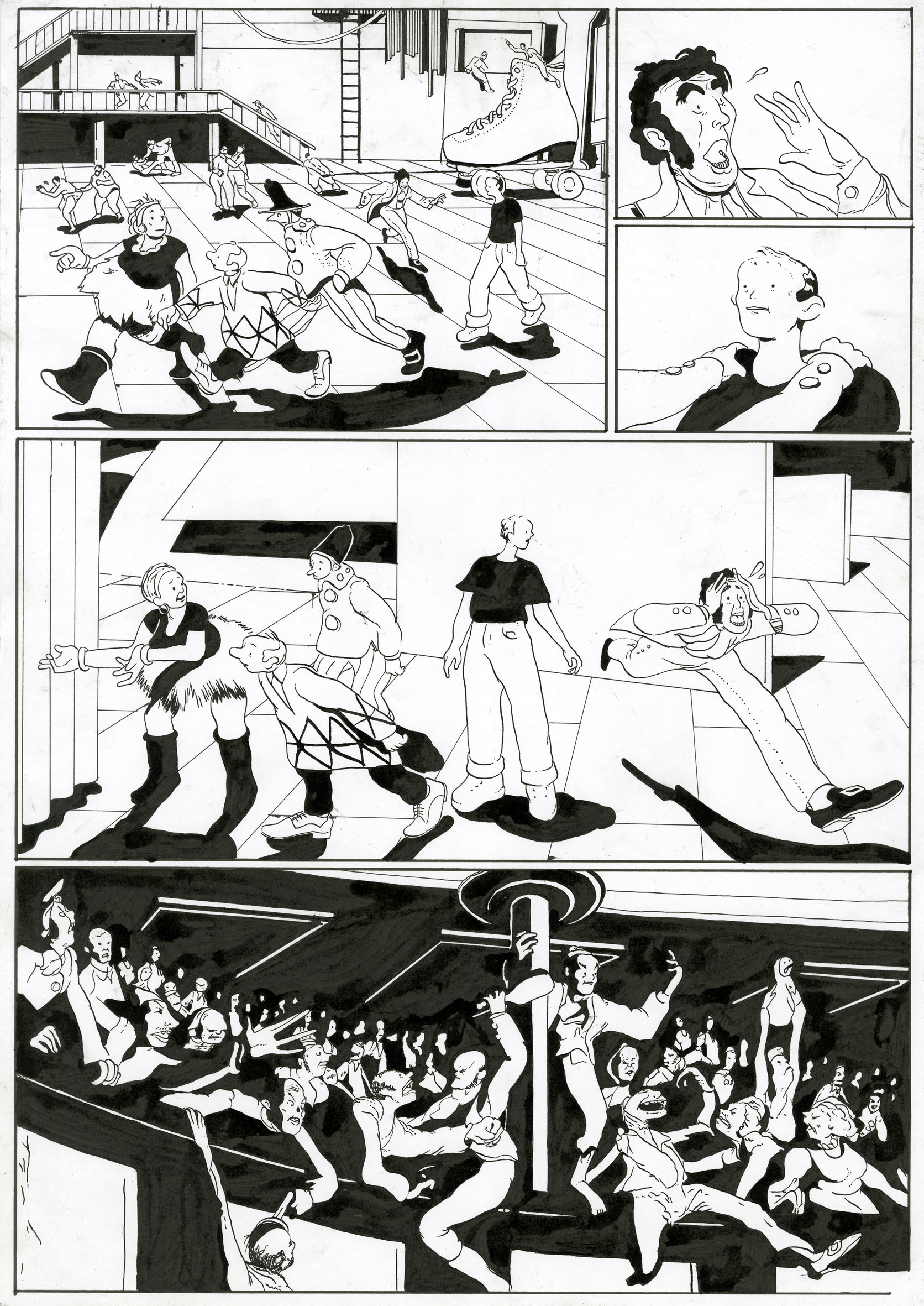
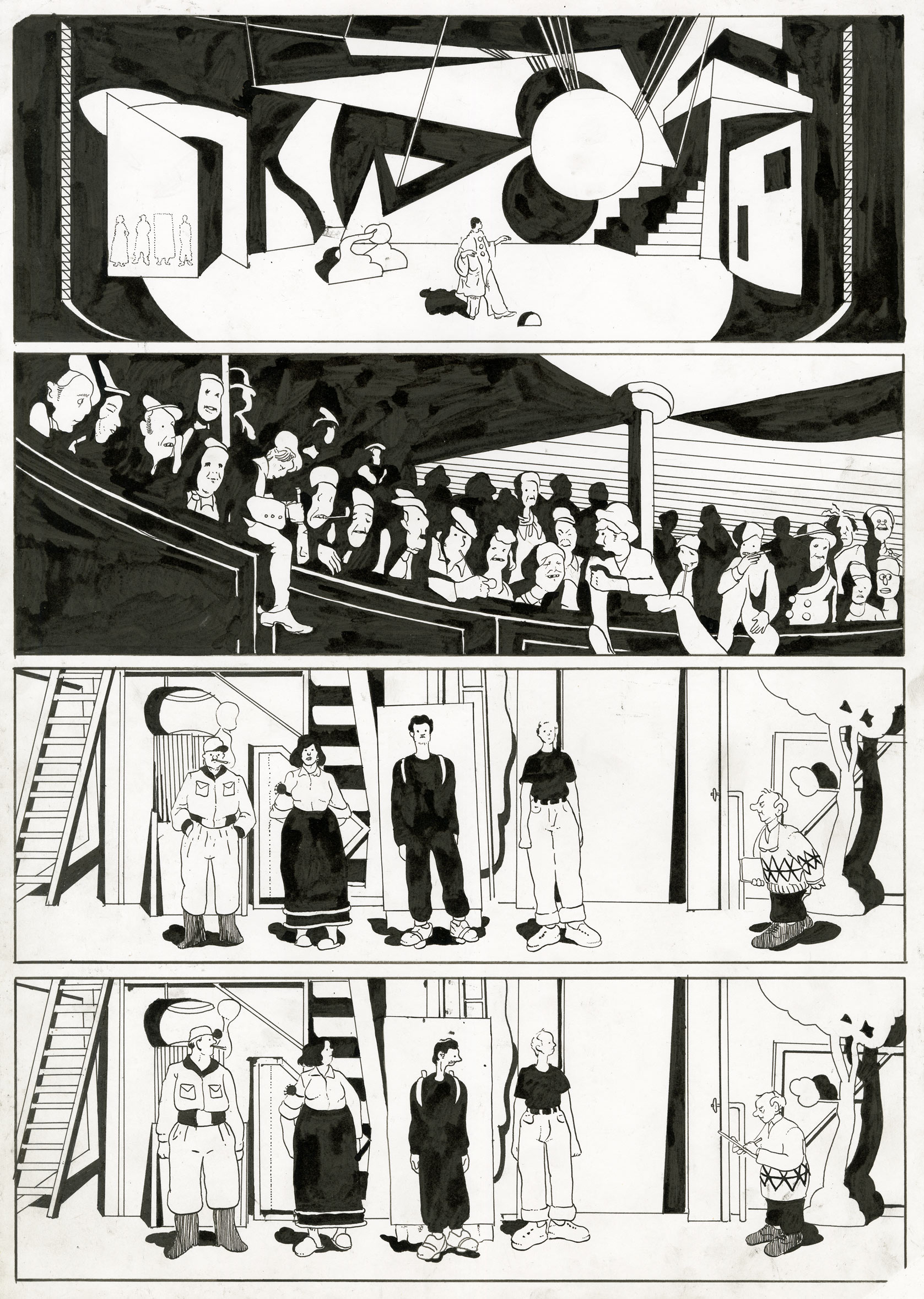
In Genís Rigol’s first comic book, Brunilda à la Plata, published in 2025 by Éditions Virages, the artist – also an animator and author of self-published short works – displays a confident mastery of composition, movement and mise en scène. Rigol’s panels, initially conceived in black and white, sweep the viewer along as the energetically paced narrative progresses. More masterpiece than trial run, Brunilda à la Plata establishes itself as a space for experimentation where memory and fiction intersect with a meditation on the creative act itself. It places Genís Rigol firmly within the new generation of authors who are rethinking the comics genre as a visual and conceptual medium capable of setting up a conversation with other art forms.
The Huberty & Breyne - Chapon I 21 gallery is delighted to be showing a selection of original plates by this Catalan artist from 18 April to 16 May 2025.
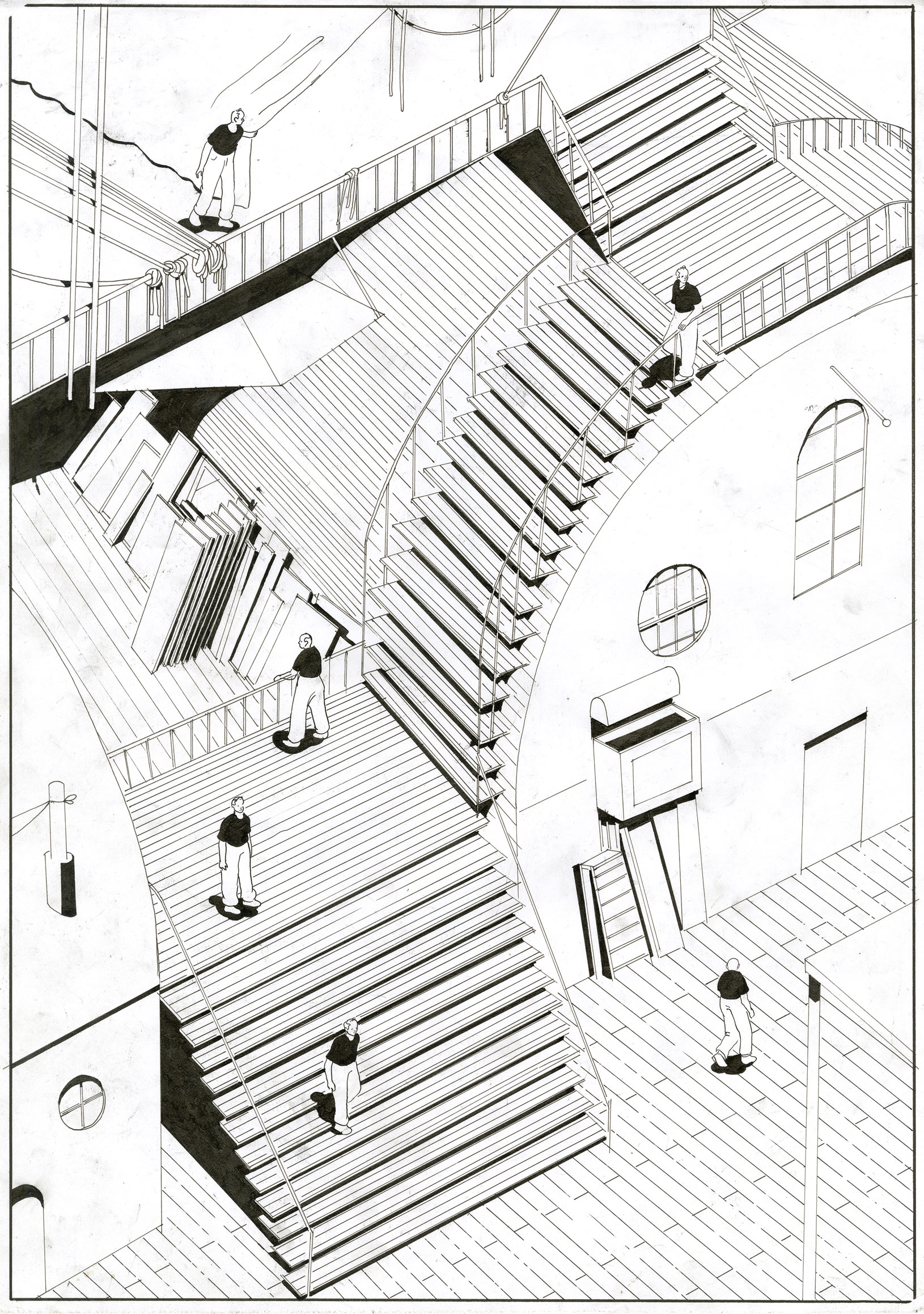
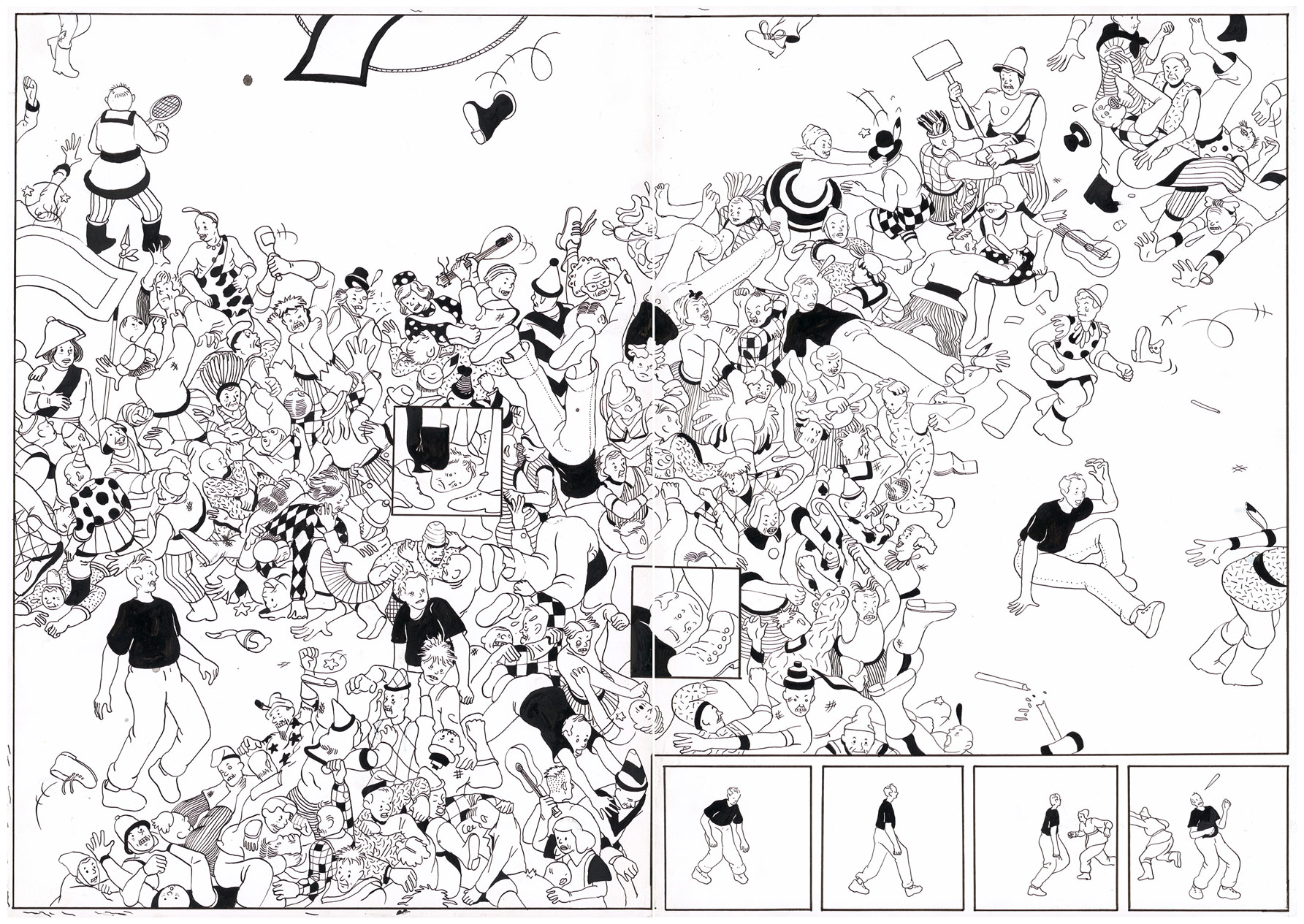
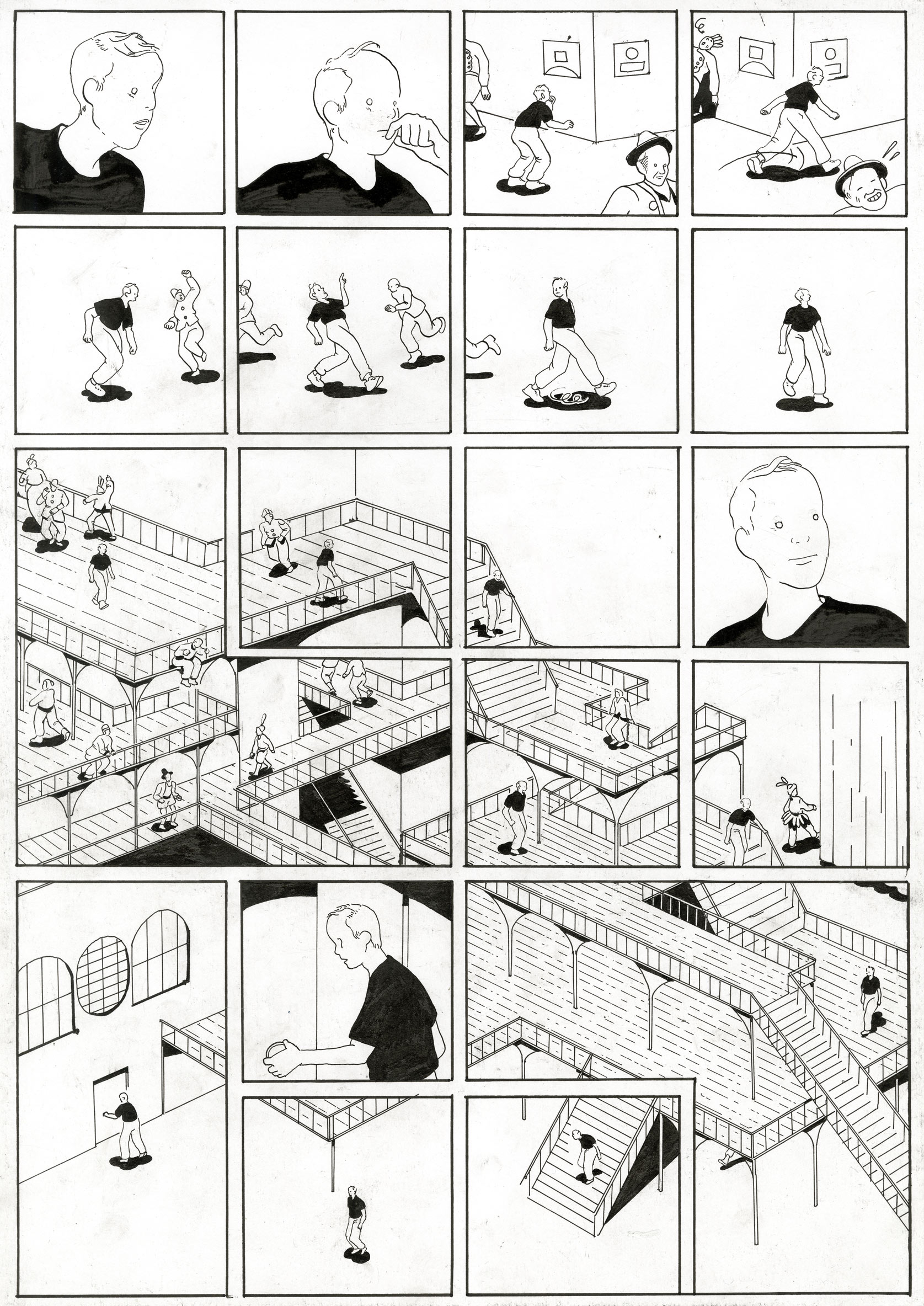
It all began with a dream the artist had in 2019, and from this dream material Genís Rigol has spun a timeless narrative. “Brunilda à la Plata” – a title but also a scribbled note. A time – 9.00 pm – and place, and the promise of a meeting… Brunilda lends her name to the book but paradoxically – like Samuel’s Beckett’s mysterious Godot – fails to appear. Her face initially concealed by speech bubbles, she is elsewhere, “off-camera”, like a vanishing point, an absence around which everything else is organised. To get to Brunhilda, Norman must walk across a stage where an epic play is unfolding, a seemingly endless production waiting for its creator – wracked with self-doubt – to write that ending. Initially lurking in the background, the playwright soon finds himself at the heart of the narration, caught up in a mechanism beyond his control. Trapped inside the creative process, he advances with his doubts, “walking arm in arm with his frustration”. A prisoner of his own ambitions and of an inner voice – his bad feeling about himelf – which constantly belittles him, he becomes in turn a person everyone else is waiting for. The audience is growing impatient and all around him things are in turmoil. Backstage, the actors and technicians are hanging on a word that never comes. With no parts to speak, they depend on the playwright for input, while the latter depends on his painfully faltering inspiration. The theatre thus resembles a closed ecosystem where everything is interdependent. Everyone is waiting for something to happen – the audience, Norman, the actors, and the playwright himself. The agitation spreads and the play tips over into farce, an allegory about artistic inspiration, populated by “evil spirits”, those inner voices that undermine the creative impulse. The theatre has become a labyrinth, an architecture of the mind – a maze of emotions and neuroses out of which the playwright’s memories surface.
Initially conceived in black and white, the original artwork fully exploits the blocks of black to structure the page in a dramatic fashion. Genís Rigol envisions the double-page spread as a stage waiting to be inhabited. The reader's gaze moves along complex trajectories, sometimes disoriented by changes of scale or structures reminiscent of the work of M.C. Escher. As in the case of Chris Ware, the page is not simply a succession of panels: it becomes a complex device where each element—framing, rhythm, movement, repetition—contributes to the construction of meaning. Space is unstable: staircases lead nowhere, perspectives are distorted and the wings of the theatre multiply ad infinitum. The theatre itself oscillates between real place and mental projection. And the characters fully participate in this strangeness, their allegorical dimension accentuated by their frozen faces, resembling antique masks, and eyes reduced to marbles. This stylisation contrasts with other, more detailed, passages, notably in the flashback sequences. Rigol’s line work is radically different here: inspired by Shigeru Mizuki, it is both more realistic and more delicate, rendered in sepia tones in a quasi-documentary style that contrasts sharply with the abstraction of the rest of the narrative. The drawing shifts from expressive caricature to meticulous precision, navigating between the burlesque, the grotesque, the dreamlike and the theatrical. When colour makes an appearance, it acts as a supplementary layer that is often off-kilter and has an almost unreal quality. Rigol’s “timeless” palette is reminiscent of the imaginary universes of Richard Outcault and Winsor McCay. In Brunilda à la Plata, the drawing transcends its narrative function, constituting the setting itself for the creative crisis, where the controlled meets the out-of-control. If, as William Shakespeare writes, “All the world’s a stage”, Brunilda à la Plata reveals the fragility of that world: the stage – a mental and labyrinthine construct – threatens to collapse, resolution eludes us, and comic strip is a space where roles, absences and emotions endlessly intersect.